Friday, January 24, 2014


I grasped the toddler chub of Midori’s tiny hands, her arms swinging wildly as we made our way across the street, to the urban sanctuary of the park near our home. My daughter tore away from me, and raced up the hill to a small pond near the community garden. I found her staring into the glass surface at the reflection of her round face, the lily pads floating like small green tortillas, and the ducks lined up like battleships as they waited for a crumb of bread.

Look, Mama! The nubs of her fingers have disappeared inside the shiny red plastic purse she has carried with her. Acorns, rocks, pennies rattling inside a tin Band-Aid box, the sticky skin of an onion peel, a piece of white paper that she tells me looks like a thin cloud. All the reserves of a three year old in love with the world come tumbling out of the purse and onto the cement rug near the pond. Finally, her eyes are alive at the realization that she has found “it.”

Proudly, she holds up the squashed remnants of a small tangerine. Her hands are covered in the syrup of the crushed fruit. Bits of pulp cling sternly to her skin, and the long strands of pith hang down like exposed veins. No sooner do I frown at the mess than Midori, reading my expression, crumbles on the concrete. Her face is red and hot, and she has spit coming out of her mouth as she makes soft crying noises. When there are no tears left, she offers only, I brought it for you, Mommy. So you wouldn’t have to worry about your diabetes. So we wouldn’t have to go home if you needed to eat.

I wanted to be far away from that moment, when I realized the impact on my daughter faced with the unpredictable reality of a mother having a chronic disease. I wanted to be tethered to a runaway balloon, like a tiny dot in the sky, weightless and unburdened. Instead, I was staring down the accusation of time stolen by diabetes. Not the months and years that diabetes can poach if neglected, but the seconds, minutes and hours embezzled by checking and correcting blood sugar.

Diabetes can be a disruption to the rhythms of living. It is waiting in the corners of every moment I am alive, sometimes remaining quiet and sometimes galloping into the room. That my children might be conscious of its presence, and at such a young age, was a revelation. My daughter’s small provision, her mangled tangerine, was the bracket that held her worry at a distance so that she might fear less, believing that her meticulous planning would secure an afternoon together without the threat of disarray.

Years before my diagnosis, I too had vicariously lived the legacy of diabetes. My grandmother had been diagnosed with type one as an adult, and my earliest memories of her often involve watching as she measured each particle of food with porcelain scoops, observing the shimmery droplets of blood she squeezed from the tips of the fingers that rubbed soap on my back in the tub, scrutinizing the slick needles that she drove into the pink skin of her hips. She tended to her diabetes with the gentleness of a woman tending to a crying baby, without any hint of bitterness or loathing. My grandmother took the time she needed to care for herself, like little bits of string that she sewed through moments and days and on into years until, at last, it became the blanket in which I wrapped myself after diagnosis, taking comfort in the warmth of her legacy and the vibrancy of her life.

My own mother, by comparison, treated her type two diabetes as though it were a little bit apart from her and the reality of her body. It was an abstract element that made her depressed and hopeless, and she could never grab hold of that thing, embrace it or discard it, push it aside and rise anew. As she aged, she was buried under the weight of that burden until, at last, she was bathed in the manifestations of the disease she had neglected. Her body was swollen, and fluid would literally seep from under her skin, through her pores, puncturing the taught flesh of her legs and stomach. Her feet were cracked. Her limbs were numb. She spent the last years of her life on the brown sofa next to the window in the living room – a room I often joked should be called the “waiting room” as my mother sat only in anticipation of finality. That was her life. We sat together sometimes; with me watching the two green apples of her eyes fill with sadness, stroking her hair because it was the only part of her that didn’t ache. I remembered lying next to her as a child, pressing my nose into those same thick, black locks and smelling the yeast from the bread she baked, and I thought that you didn’t have to die to be gone.

Staring into the wells of my daughter’s eyes as I deflated her pride at having taken such careful measures to shelter me from the impacts of my own disease, I wondered about the legacy my life with diabetes was imparting. I wondered if my daughter had inherited my sense of worry, as I had promised I would never inherit my mother’s place next to the window. I wondered if I was making the best of living well with diabetes or if I simply seemed to be coping acceptably with the circumstances I had been given.

Since that afternoon in the park, I have been mindful to speak honestly and openly with both my children about diabetes. I remind them that checking my blood sugar is an act of self-love and never a reason to be fearful or insecure, that making adjustments is part of taking care of my body so that I might be fully focused on those around me. I remind myself that my experiences with diabetes can shape my children for the better, making them more compassionate and empowering them to take the best possible care of their own bodies. I am unapologetic about taking time for myself when diabetes demands it, just as I would take time to care for a child with an emergent need.

No matter how much I wish diabetes would not leave marks on the animas of their beings, I recognize that the imprint can come in the form of painful laceration or a tender graze of the skin, and I choose the latter. It is a careful recalibration of the moments that we all share as we throw open the doors to living with diabetes.

Wednesday, January 8, 2014


I had imagined a life. Somewhere, someone is probably living it. I am not.

Five years ago today, our son was diagnosed with every condition you can’t imagine: communication delay, receptive language delay, expressive language delay, central auditory processing disorder, sensory perception disorder, compromised immune function, fine motor delay, gross motor delay, hypertonia, autism. (That is the short list.)

There was a lot of pain and disappointment in getting to that day. Our son was born prematurely, and had emergent medical challenges from the moment he came into the world. As he grew, he was anxious and sometimes violent. He was dismissed from six nursery schools. He had been hospitalized and nearly died from multiple respiratory infections. He had seizures. He couldn’t speak, and he had eaten through every wooden object in our home – gnawing incessantly at his bedposts, the railings on the stairs, the coffee table. We had taken him to doctors, speech pathologists, occupational therapists. It was hard.

And that day was hard, too. Not because he had autism. We knew he had autism. We had spent three long days at the Child Development Unit in Children’s Hospital, watching a team of experts watching our son. All of us, spectators to his failures. All of us, knowing he was autistic.

The hard part came after the diagnosis. We sat, in silence, for a moment. I was waiting for someone to tell me what to do next…what services to access for him, where to begin looking for providers, what kinds of things would be covered by our insurance. Instead, the panel of medical professionals asked me, “How do you feel about Henry, having autism?” And when I made the important inquiries, they replied, “We can’t tell you those things. We don’t know.”

I was pregnant. They told me our daughter might share the chromosome defect that caused Henry to face so many challenges. I had just been diagnosed with Type I diabetes. The world was coming apart.

I thought of my Grandmother, who also had Type I diabetes. I thought of the last book I brought to her, as she lay dying. She loved adventure novels. I gave her Touching the Void by Joe Simpson, recounting his and Simon Yates' successful but disastrous and nearly fatal climb of the 6,344-metre Siula Grande in the Peruvian Andes in 1985. After plunging 150 feet, Simpson regains consciousness only to realize that he has a broken leg, and his only hope of surviving is to reach base camp. He cannot focus on the big picture, of getting to his end goal. The task is so monumental that he fears he will lie down in the snow and die. Instead, he focuses on making it to the crevasse ahead of him, or the steep rock ledge. Of moving for another half hour, fifteen minutes, ten seconds. Eventually, after three days of crawling and hopping, he makes it to base camp.

That would be my life for a long, long time.

I couldn’t bring myself to look ahead. I couldn’t consider all the things I had to do, all the things that might go wrong, all the possible culminations of my efforts. Instead, I would wake up and decide, “Today is the day I will teach Henry to wash his hands…to use a spoon…to put on his pants.” I couldn’t think about the thousands of dollars we were spending every month to access speech therapy or occupational therapy….the depleting of our life savings and the stack of insurance denials. Instead, I paid the bills one by one, thinking only of how I would afford that particular service for that particular month. And, somehow, each effort stacked on the other, and it became a life not of parts and pieces, but one of overcoming and transformation.

I have learned what it is to be human.

I learned that we are hardwired to experience pain. We are, in fact, built for it. As much as we run away from hurt, it is intrinsic and important. In our efforts to dull its sharp edges, to medicate it away, to assuage it into oblivion, we miss the crying baby that is our own sometimes anguished existence. The only use for pain is in surrender to it, so that we might someday walk through the other side as better people.

I learned to love unconditionally. I could not afford to love my son for the things he might do in life because, based on that first bleak prognosis, he might have done nothing at all. I had to love him just because he was mine to love. I had to love him as he was. I had to love all the parts of him, including those that had been pathologized and labeled “autistic.” And then, I wondered, could I love myself that same way? Without condition? And I learned that I could.

I learned that the future is really just a terrifying, heartbreaking illusion. It doesn’t matter who you are, or how healthy your children. There is no such thing as “the future.” It’s just an idea that we have, along with a lot of other ideas that are not the least bit rooted in reality. It’s a dream, an apparition, a myth that we weave because if this moment were the only purposeful one, how would we spend it? Doing….this? And so, I learned to make my moments count. Not absolutely, of course. No one can live each moment with intention, but we can find a meaning in every single day of our lives.

I learned that there is a diverse pool of humanity, and it is that very range which makes possible progress in science, the arts and humanities. Variation has value, and what might seem outwardly disabling might only be limiting because of a narrow world view as opposed to something intrinsic about the person. “Ability” and “disability” are situational, contextual concepts.

And so, as it turns out, I learned that the life I had not planned and perhaps did not want has turned out to be a good one. The best one. And, of course, my only one. I don’t love my life, my children, myself because it is a strategic investment in what might someday be. I love because it is enough, all on its own.

Five years ago, I could not have known.

Wednesday, November 13, 2013


I’ve disclosed my diabetes to thousands of people over the years. Sometimes, the reveal  is made in the context of friendly dialogue, sometimes because the other party actually needs to know as a matter of safety or medical practice, and sometimes I’m sharing my diabetes story to a room filled with people as I am giving a talk on racing a bike and living well with the illness. As you might imagine, I’ve had every possible reaction, ranging from surprise to pity. I’ve been met with every possible follow-up question, anecdote, sympathetic nod, impact story and the occasional awkward silence.

The best reaction I ever received was none at all. It came from another cyclist who had, over time, heard me casually mention diabetes in our conversations. He’d watched me check my blood sugar and observed me employ every diabetes device in my possession, and all without so much as a hint of interest. It wasn’t his own discomfort with my disease that kept him quiet, or any respect for my privacy. Simply, of all the things he knew about me, diabetes was the least interesting among them.

Different people have varying degrees of experience with diabetes and different levels of comfort when it comes to talking about the disease, and some diabetics struggle more or less to speak about what it is like to live with this illness as a constant companion. In honor of the upcoming World Diabetes Day, I thought it would be befitting to share the Nine Things You Should Know about Diabetes.

1.       There is more than one type, and the disease processes between Type 1 and Type 2 are very different. In some regards, it’s unfortunate that the two distinct disorders share a namesake. In Type 1 diabetes, the beta cells produced in the pancreas are attacked by the other cells of the body. Eventually, the pancreas stops producing insulin. Without insulin, the body is unable to remove sugar from the bloodstream and convert it to energy. People with Type 1 diabetes must check their blood sugar throughout the day and inject insulin. In Type 2 diabetes, receptor cells are unable to utilize the insulin produced by the body. This can happen for a myriad of reasons, but is often related to excess body weight and fat cells, or a sedentary lifestyle. Insulin resistance leads to less sugar being removed from the bloodstream.  Patients with Type 2 diabetes may need to use insulin, but can often manage the disease through lifestyle modifications or oral medications, or use other injectable medicines to maintain a normal blood sugar.

2.       There is no cure for diabetes. No juice fast, cinnamon oil, beet extract or raw diet will remedy my disease. While those who suggest otherwise are no doubt well-intended in their recommendations, it’s important to understand that diabetes management is more complex than any multi-level-marketing-scheme or recently viewed YouTube video. I trust these peddlers do not intend to be insulting, but it is seemingly offensive to hear superficial comment on something they don’t fully understand (after all, if they did have a grasp on diabetes, they would know that I can’t be cured by these “quick fixes”).

3.       Diabetes sometimes impacts our mood and our reactions to those around us. While it’s not really fair to blame bad behavior on disease pathology, swings in blood sugar can make someone with diabetes less than amiable. Irritability can be a side effect of high or low blood sugar in itself...and the frustration of not feeling quite right can make someone with diabetes angry, as well. Diabetes can be a disruption, and that alone can elicit an emotional response. Be patient and, when in doubt, ask what you can do to help.

4.       People with diabetes can live normal lives. Proper disease management is crucial to stay healthy and to feel good, but assuming that someone manages their diabetes appropriately, there is no reason that a person with diabetes can’t do all the things a non-diabetic might do. To translate: Steel Magnolias is a dramatic movie and not a documentary.

5.       In order to stay healthy, we have to use some needles. If that makes you uncomfortable, look away. Most diabetics will check blood sugar or inject discreetly, so it’s probably not a huge issue. And while some people might choose to politely excuse themselves from your presence before sticking a finger or drawing a syringe, others prefer to do this as needed without having to step aside. The kindest thing you can do is to do nothing at all. It’s really hard to manage diabetes when you feel awkward testing or correcting in the presence of another person. If someone is hesitant to use a needle in front of you, kindly reassure them that it’s no big deal.

6.       It is no big deal. I once finished a race, and whipped out my meter to test my blood sugar. I felt fine and, in fact, I was fine. I was a nice 108. That’s just about perfect. My competitor, however, came running over to me and inquired in a state of near panic as to whether I needed some emergency juice. She was, of course, trying to be kind and useful, so I gently explained that checking blood sugar doesn’t mean that something is wrong. Quite the opposite, in fact. Testing blood sugar is how we prevent things from going wrong, and it should never be cause for concern.

7.       Do not lecture someone on what you think they should be doing. It is no more or less healthy or problematic for me to eat a piece of pie than it is for you to enjoy the occasional bowl of ice cream. As adults, we can make our own decisions about disease management, and however well intended your commentary, it will no doubt come across as controlling.

8.       Go ahead and ask. I was at a party the other night, and a couple of friends asked me about diabetes…where I inject and whether I take my insulin on the bike, and how much I need to eat to feel good when I race. The questions were asked with genuine interest. This kind of discussion is always refreshing because it comes from a place of authentic regard. It’s not about selling me a product or judging my behaviors; it’s about learning more and trying to understand my situation. I welcome those interactions.

9.       Diabetes is just one part of my life. It’s a big part, no doubt. I think about diabetes every day. Several times every day. The first thing I do in the morning is check my blood sugar, and I check it again right before I fall asleep…and maybe ten times in between. It’s like constantly keeping the ambient air temperature at 72 degrees without the benefit of a programmable thermostat. But there is a lot more to who I am and what I do than what is captured by simply “living with diabetes,” and I really want people in my life to focus most of their attention on those things.

Monday, October 28, 2013


Things were unraveling. Or maybe I just felt like I was coming undone. Our daughter had been diagnosed with a learning disability. Our young son with autism was struggling to simply remain in a classroom, and I was flooded with daily phone calls from his various therapists and educators, all trying to arrive at solutions. For a time, he had stopped speaking at all, choosing instead to type his every request. If anyone insisted he speak, he would hit them. He had been removed from his after school program, making it impossible for my husband and I to work past two in the afternoon…making it hard to pay all those therapists and private tutors tasked with helping him. (Never mind the bitterness from my business partner, who was tiring of the situation, as well.)  And then the worry, the burden of wondering if he would always struggle and us, too, vicariously…

My husband and I were turning on one another under the mounting stress. At first, it was simply the tired snapping of two people, lost in a sea of problems. And then, soon, the million little jabs of resentments had bloomed in to the brand of silent seething that might threaten an otherwise good marriage. Do you have to cut the bread like that and Why can’t you change the light bulb and Couldn’t you read the bedtime story were criticisms lobbed so gracefully that the other party could hardly object, though both my husband and I knew the words were pregnant with hostilities unspoken.

It was in the middle of all this that I boarded a plane to Seattle. I had a speaking engagement, and had decided to meet an old friend while I was in town. My schedule was tight, as always, and I was giving consideration to cancelling until I realized how much I needed to have some time to share the deepest parts of my life.

And that, really, is what this particular friendship has been about…it’s about that place where the soul can stand naked, sheltered from exasperation or recrimination, and know that it will be received with unconditional acceptance. Our friendship is the home where I can be my true self.

My husband, of course, is my best friend. He’s my cheering section and my partner and my source of love in the world. But marriage requires the kind of work that friendships do not and, of course, in marriage we are exposed in a different context. In marriage, we cannot strip ourselves bare and open the doors to the basements of our thoughts and fears because those things, those recesses of us, have repercussions for the partnership. Friendship requires no such negotiation.

And so, I found myself sitting outside a café with the mist of Puget Sound dampening a paper cup filled with hot coffee, at my absolute neediest, and with my dear friend at my side.

We met years earlier, having been paired for work. He was an enthusiastic talker, animated and gregarious. I liked him straight away, even after he reached over and grabbed my thigh in the middle of a discussion about racing bikes and becoming faster. His intent, however, was not the least bit subject to question as he quickly moved on without so much as a glance in my direction, saying, “You look like a Schleck brother with a bit of muscle.” And quickly, to the next topic.

He found humor the morning that I called him after I got lost on what was supposed to be a short run, and ended up being well over 13 miles of aimless jogging. To this day, he references with laughter my poor sense of direction and inability to read a map. Also a diabetic, he encouraged me to tighten my already “tight” control over my blood sugar, and then showed me how. He was forgiving on the occasion of my two in the morning rant, months earlier, when I sent him what he later called “the longest text message in the history of the cell phone” as I found myself panicked about the future and unable to sleep. He has counseled me through the hardest days of raising my children…at all hours of my life, when I have needed him most.

Despite living thousands of miles away from one another, it’s possible to transcend the limits of skin in a friendship. It’s the kind of relationship that has taken me out of the boxes I have made for myself, and burned them up. This kind of friendship is not a frivolous connection, a supplementary relationship to the ones we’re taught and told are primary – spouses, children, parents. It is bread for living.

And so, we sat together and talked. But it was less about talking, and more about being. Being as opposed to Doing. Sure, we spoke about all the things we do - in our jobs, our other relationships, our spiritual, athletic, medical, familial doings. But the experiential, life-giving juice that feeds our soul and binds us together over the years and takes us to ever deeper dimensions is the conversation we have when we are just present for one another.

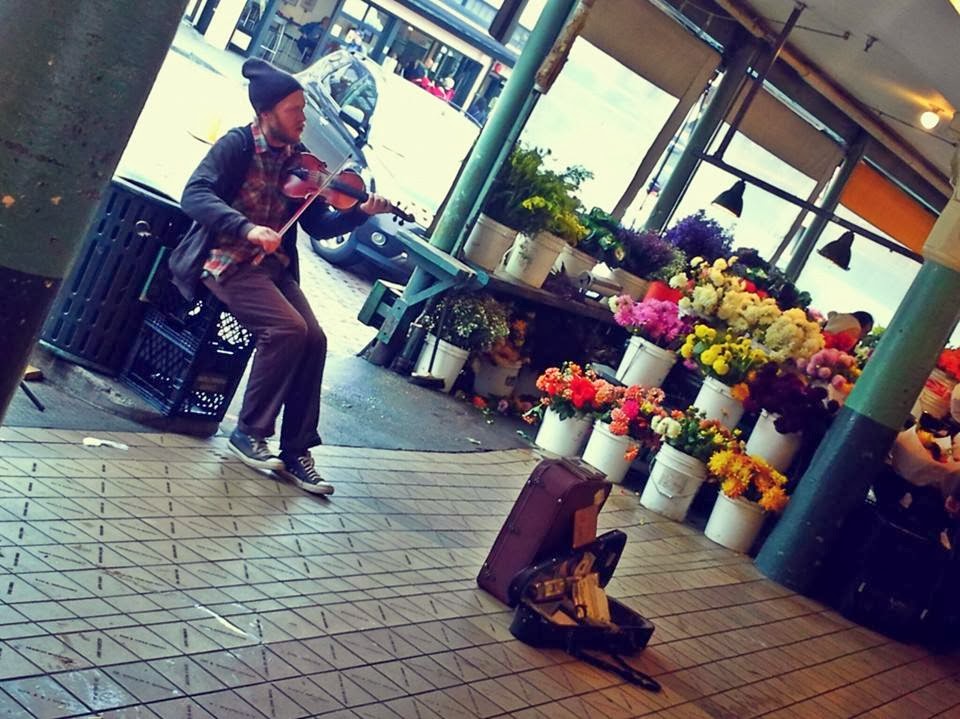
He had made reservations at a nice vegan restaurant on the other side of Seattle, but I found myself in love with Pike Street. I needed to be in a place where things seemed alive, where there was the movement of feet and the salt off the water, the smell of flowers in the market and the glassy eyes of fresh fish laid out for sale. The vibrancy of the marketplace seemed to lighten the burdens I had carried with me down the bricked streets and to the edge of the water.

You won’t find a lot of vegan fare here, he said. And then, smiling, I replied that I knew…that maybe I would order a giant plate of fish, instead. We both began laughing, as he took me by the arm to a restaurant where we ordered a huge plate of mussels, drowned in a seafood broth, and then salmon and whitefish. We ate and talked for a long time with the ease and openness of old friends. For as much as he talks, he is always fully present. He is acutely open to my true self, and he is with me always in the moment. And as we left, as we walked through the busy streets, as he handed me a tart Washington apple and as we stared at freshly baked bread, I found myself grinning so hard that it hurt.  In the oasis of our friendship, I found myself renewed. For the first time in months, my heart and mind felt light.

Support, salvation, transformation, life. In the worst moments of my mind, my friendships have moved me from the surface of this life to the meaning of it. We help one another live. Standing naked before another, knowing that acceptance will trump exasperation. As we hugged goodbye, I was reminded of how lucky I am to own this life. I walked through the door of my house a happier, more generous version of myself.
 

Friday, October 11, 2013


Why didn’t you sign me up? Why didn’t I get to go to gymnastics like Midori?
Deep breath.

I had enrolled my five year old daughter in a Thursday night tumbling class because she really wanted to own a leotard - a sparkly red and black leotard with a giant gold star on it, to be specific. I figured it would be a good opportunity for her to wear tight and tacky clothes and roll around gracelessly. Turns out, I was right. What I had not foreseen was that her older brother, Henry, would think it looked like a boatload of fun. Or maybe it looked more fun precisely because he was excluded. Either way, as we sat in the viewing room above the gymnastics studio with a group of parents observing their children somersault and swing and jump and kick, Henry became increasingly upset.

How am I going to explain this to him? How can I tell him that this would never work? That he can’t participate?
Henry’s done a lot of organized sports, and with a good deal of success. He is an accomplished runner and has enjoyed soccer and basketball, too. But gymnastics is different. It’s pretty much incompatible with everything autism. In fact, when Henry was a toddler, we tried to take him to a parent-child gymnastics class, only to find him unwilling to participate, seated in a corner with his hands over his ears, rocking and screaming to himself. Not a resounding success.
The room is loud and echoes. The fluorescent lights flicker incessantly. There is a large group of children with only one adult to supervise. The tots have to hear instructions and follow directions. Things are often done one at a time, so there can be a lot of waiting around, patiently. It’s all about imitating the actions of another person.  The activities require fine motor skills. And, most importantly, I would be seated in the viewing room since parents are not allowed on the floor. Henry wouldn’t have the benefit of intervention from someone who knows and understands autism, someone who can provide the sort of gentle direction and redirection he often requires.
I had a million reservations. I was going over the list in my head: All the reasons Henry would find this frustrating, all the reasons it would fail. I imagined the instructor pulling me aside after the first class, and telling me that she would issue me a refund for the rest of the term. And then, I looked at Henry who had tears welling up in his eyes as he emphatically stated that he wanted to be with the other kids and do what they do.
Love is not tied to performance or accomplishment. I love my son not in spite of his incessant, repetitive questions or his tics and tantrums…I love him just because. Just because I choose to fill my heart with an ineffable, unstoppable and totally undeniable love that persists and sustains no matter what he does. That’s not to say that I don’t celebrate when he is successful. When he does something generous or wonderful, my heart swells with pride. When he struggles to write his name or screams uncontrollably for an hour, I can feel depressed and overwhelmed. But I am learning about a love that is bigger than all that.  
So, setting aside all my reservations and every expectation, I registered him for the next session.
 
 
Yesterday, after school, he ran home, dropped his book bag at the door and got dressed. His gym shorts were on backwards, his t-shirt inside out. Henry is ready for gymnastics!
Walking to the studio, with Henry’s hand clasped tightly around my own fingers and the sound of his familiar humming surrounding my ears, my previous reservations faded away. I learned long ago that Henry’s behaviors were not pathological, but purposeful. He hums to recalibrate and feel a sense of safety in himself. It’s actually kind of peaceful.
And that, really, has been my lesson to learn as Henry’s mother. When people do things that I find odd, I often judge or distance from them. But what if I were to consider that there might be reasons behind their behavior? How would my relationship to the world change if I spent less time judging what I don't understand, and more time building connection?
And so, in the spirit of suspending expectation, I dropped off my son at the door, and went to watch from the seats in the observation room. The instructor examined Henry’s attire, watched him spin a few times in the line of children, and nodded politely in my direction.
For the next hour, my son tried his best. When the other children crab-walked across the floor, he crawled in an attempt to emulate them as best he could. When they did a series of high kicks, he jumped up and down, with gleeful, erratic motions. When they bent down to touch their toes, he fell over, got back up, and tried again.
 
He sometimes ran about when he was not supposed to be moving. He preferred to simply hop on the trampoline than to attempt any of the tricks. Once, he ran out of the room to examine the brickwork on the wall outside. He often spun and flapped his arms and, through the sound proof walls of the observation room, I could see his lips purse in a constant, low hum. The other parents in the observation deck had their eyes trained on me, clearly wondering what was different about my son. Some had a look of obvious annoyance, others were merely inquisitive. I long ago shed my inhibitions, and I was proud of him for trying, proud when I watched him boldly walk the length of the thin balance beam, proud that he persisted. Henry was smiling. He was having fun.
When the class ended, I went to collect Henry from the waiting area.
How’d he do?
The teacher grinned. She looked at my son, smiling and clapping his hands over and over again.
He was brilliant. No one had more fun today than Henry. I hope he will be back next week!
Every day, I am participating in the miracle of my son. Lucky me.


Tuesday, October 8, 2013


I spend a lot of my life looking at pavement. Even when I’m in the car, I am staring at the asphalt ahead of me, the rises and descents, and I am thinking about riding that stretch of road. I can feel my wheels on the tarmac, the air around me and the beat of my heart competing with gasps and exhales as I am carried over steep pitches and along flat, smooth stretches. The feeling of weightlessness that accompanies speed holds me in a relentless grip, even when I know that the ride will be hard or painful.
The bike is an intoxicating blend of liberty and doom. The paved road is the closest we will ever come to flying. Dust and mud kick up around us, covering our tongue and teeth. I’ve taken more than a few sips from the lip of a water bottle, only to be left with the grittiness of earth mingled alongside a gulp of liquid. It’s as if we taste the road on which we are traveling.
This week represents my transition to what is sometimes known as the “off-season,” but is really more about the collision between shorter days and cooler temperatures.  In Colorado, it means the hypnotic dripping of rain, the warmth of early afternoon rides giving way to arms and legs dotted with goosebumps and flesh cold to the touch by dusk, the smell of dried pine needles and the end of ambition. It’s when I ride my bike for the simple sake of sensations, and not to be better or faster or stronger. This is the time of year when I grateful to simply ride at all as opposed to being resentful and disappointed if I failed to sneak in an effort.  

This is the time I remind myself of the simple pleasure of riding a bike.

Before long, I will be back to worrying about the pains of intense efforts, the strength in my legs, the weight I carry uphill. I actually look forward to that shift toward fitness, too, with the palpable rewards of progress, measurable improvements, and the momentum of incremental advances toward my goals. That process is as much about attaining objectives as it is about the evolution of the rider.  But in the science of cycling and the work of getting ready to race, there is the opportunity cost of true hedonism.
So, for the next couple of months, I will take a break from clawing my way forward. Instead, I’ll plan mid-day rides with good friends, take a few moments to smell damp earth and feel the flushes of wind and sun alternating through time, and enjoy the ride.

Tuesday, May 21, 2013

Why I bought my son an ice cream cone for lying...

In our home, media access is an earned privilege. Twenty minutes of coveted time on the iPad comes at a price. For Henry, our son with autism, this reward is granted only after reviewing his daily behavior sheet from the school. Assuming he has less than five marks for disruptions or refusals to comply with classroom requests, he may play a game or write a story while I cook dinner. If he has not met the given criteria, he gets to spend some quality time chopping, peeling, dicing and mixing alongside his father and I as we prepare the evening meal.

I picked Henry up form school the other day, and went to open his book bag in search of the daily behavior report. Henry raced over. "No paper today, mom. They forgot it." I looked at him, questioningly.

Really, Henry? Let me see. Hand me your backpack.

He stared sternly at his toes. He then grabbed his backpack off the hook in his cubby, placed the straps over his shoulders, and backed slowly away from me. "There is nothing to see. No paper. Not today." Then, speaking in third person as his usual custom, he answered, "Henry had a great day!"

It was comical, actually. He thought he was entirely convincing. His sister glanced up at me. "He's obviously lying, mom. He obviously got in trouble." Then, spinning to her brother, "You, Henry, are a dirty liar."

Henry looked disappointed, but not yet defeated. He sprinted out to the car, clutching the zipper on the book bag.

Finally, as he buckled his seat belt, I grabbed his bag. He reached for it, but then gave up. I opened the zipper, and looked at a sheet littered with marks. He waited.

Henry, it looks like you had a hard day. Some days are like that. I'm sorry it was so tough, but you can't have any media time tonight.

He didn't quibble. In fact, he didn't say a word. His sister, on the other hand, was quick to chime in: "And because you are a dirty liar, you are going to spend the night in your room. All alone. Because no one likes a dirty liar."

I sighed as Henry started to protest at his sister's directives. No, Midori. Henry will not have to spend the night in his room. You be nice to your brother.

The truth was that his lying was anything but an irritation to me. Kids lie. Kids without autism. But people with autism are known for brutal honesty because, as a rule, they lack the social understandings to weave complex tales...to manipulate. It's a social story just out of autism's grasp. Manipulation, after all, requires empathy and imagination. When Henry was first diagnosed with autism, we were told that he would lack both those characteristics. The idea that we would raise a child incapable of being empathic was, to me, the hardest notion to bear.

As any parent of a child with autism will tell you, that stereotyped characterization of the autistic is wrong. Henry's expressions of compassion are markedly different, and often socially awkward...but they are there. He once tried to soothe a crying toddler by complimenting her feet. "Nice arches. They are not so flat." And when his sister fell out of bed and hit her head, he wrapped her entire face with masking tape in an attempt to "make a Band-Aid big enough to fix her." Misguided? Perhaps. But sensitive, nonetheless.

And so I silently celebrated a milestone that is irksome to so many. I took my kids out for ice cream to honor my child's first lie...or, rather, another step in his progress toward being a part of a world that is sometimes so hard for him to fully access.

It's a bit of a Buddhist thing, that the moments which so many parents lament - My child lies - can be moments of joy in another context. It was yet another instant when having a child with a different set of rules and expectations opened me to seeing things in a different way. "Good" and "Bad" are illusions of the mind, not intrinsic realities. The things for which we scold our children can be gifts, when measured by the proper yardstick.